Showing posts with label market. Show all posts

Sunday, 25 November 2012

Colors of Kathmandu: An Intro to Nepal

I'm feeling a little nostalgic.

Our trip is winding down- only two more weeks left before we fly back to France- and I'm thinking about how things used to be. Back at the beginning. Back when it was all fresh and new.

Back when I was taking this blog thing seriously.

You don't have to tell me (although some of you already have), lately, I've been a worthless blogger. Back in the good old days, it was a blog post a week- sometimes more. These days? Well, let's just say that, even after a decade with the same person, I'm having sex more often than I'm blogging.

And what's my excuse? I have the time: I was on a tropical island for an entire month doing absolutely nothing except making a few drinks. I have the motivation: many of you have been following this blog for nearly two years (for those of you who have- THANK YOU!). I have the material: these last few months have been some of the most interesting and eye-opening of the entire trip.

No, it seems that, as the trip slowly comes to a close, there's a part of me that is finding it harder and harder to share this part of my life. Like I don't want it to end so much that I'm kidding myself into believing that keeping my experiences to myself will make the trip last longer. Like taking the time to document it is taking away from the experience itself.

The thing is, I like blogging. I love sharing this with people who are interested in something that is so important to me. I'm doing this for myself as much as anyone else. It's just that lately, I've been wanting to savor every second living these last few weeks, not writing about it.

But that's not fair. You, who have followed me throughout this adventure, deserve more. So, once again, I owe you an apology. And, more importantly, I owe you a timely blog post.

So let's get to it.

We have just finished a two week whirlwind tour of Nepal, which included a 10-day trek, a two day rafting trip and one day exploring Kathmandu. I'll get to the outdoorsy stuff in a later post (but hopefully not too much later!), so for now, I want to give you a little taste of a country that we adored, by way of a photographic love letter to it's capital city, Kathmandu.

This post is going to be picture-heavy, as Nepal was seriously a feast for the eyes. The incredible natural beauty of the mountains was breathtaking, and I'll give it the gushing review it deserves in due time, but it was Kathmandu that really gave us a feel for the colorful, multi-cultural assault on the mind and senses that is Nepal.

The very first thing we said to each other upon arriving in the city was, "It looks like India."

We had always thought of Nepal as nothing but the Himalayas, Sherpas and Buddhist prayer flags, but here, in the lowland city, we could have been in Delhi.

Granted, neither of us have ever actually been to India, but, you know, we've seen Slumdog Millionaire- that has to count for something, right? (Kinda like how Forrest Gump gave me a feel for Vietnam. I'm so internationally aware...) But lame cultural assumptions aside, Kathmandu really did look like what I imagine India to be: a riotous explosion of colors, religion, smells and sounds, albeit with a fraction of the people. Women in flowing saris of warm reds, oranges, purples and pinks, men in sweater vests that would make even the oldest, whitest golfer jealous; spicy curries, sacred cows roaming the city streets, speeding buses and trucks decorated like Christmas trees, complete with blinking lights and garland. The dusty, polluted streets, the cacophony of horns and street vendors, the Hindu temples tucked away down hidden streets and sidewalk stalls selling everything under the sun.

We f-cking loved it.

It was La Paz all over again: crazy, colorful, chaotic. Only this time, the food was better.

As much as I want to, I can't possibly do it justice in words, so here are the pictures.

Typically colorful Nepalese architecture outside of Kathmandu
Sacred or not, cows are not supposed to eat plastic bags...

A toddler playing with the prayer wheels at a temple
Rickshaw parking

So, after all my explanation and ass-kissing about how I owe my audience more, I'm leaving you with that: a half-written post and a bunch of pictures that do the hard work for me. 

I'm a blogging legend.

Saturday, 3 November 2012

Rock and Roll in Hoi An

“F-ck you, take it easy.”

We had only been at our guesthouse on the beach outside of Hoi An for an hour, but there we were, sitting at a beer bottle-littered lunch table with our host, Hoa, who was regaling us with stories from the years he fought in the war with the Marines and imploring us to “take it easy”. In the North of Vietnam, the US was the enemy, but here, in the South, it was different. Hoa had joined the Marines when he was not much older than a child and had grown up surrounded by war and soldiers, as evidenced by his deep love of four-lettered words.

“In the Marines, we were f-cking rock and roll,” explains Hoa, as he nods to me to refill his beer glass.

“People ask me: Hoa, what does it mean, Rock and Roll? I say, ‘Rock and Roll, it means f-cking take it easy.’ We didn’t give a shit- we just wanted to have a good time.  What does it mean, the Marines? It means rock and roll.”

I'll admit that before coming to Vietnam, I didn’t know anything about what the Vietnamese refer to as “the American War.” It was an important event in cultural history that defined my parents’ generation, but the only stuff I knew about it was what I had learned from watching Forrest Gump. Not Apocalypse Now, not Platoon. Forrest Gump. Now that’s rock and roll.

Sitting with Hoa, hearing him talk about his “brothers” from the Marines, some of which have come back to Vietnam to visit him, drove home not only how pervasive the war was in this country, but also how much has been forgiven. I asked Hoa the same question I had asked a moto driver that morning: Are you angry? Are the Vietnamese still angry at us?

And the answer was no. Maybe I would have received a different answer in the North, but here, the popular opinion seemed to be that what’s done is done. It’s the past. Let’s move on. Which, for someone who comes from a country where a good portion of the population still thinks that France “owes us for saving their asses in World War Two,” this willingness to forgive and forget is refreshing.
I’d be lying if I let you believe that our stay in Hoi An, which is on the coast in the center of Vietnam, was all cultural understanding and appreciation for history. It wasn’t. The vast majority of our time was spent on an endeavor that was decidedly less politically charged: Shopping.

You see, while Hoi An is a mandatory tourist stop for its lovely colonial architecture and charming old town, it is also renowned for its tailoring industry. There are literally thousands of tailors and dressmakers in the city, offering a relapsed anti-consumerist unlimited opportunities to have clothes custom made on the cheap.

I was a woman possessed. It had been such a long time- 10 months to be exact- that I hadn’t shopped or thought about shopping, that once I was confronted with this abundance of fabrics and patterns providing countless combinations to create exactly what I wanted, I just couldn’t get enough. I went from stopping my clothes addiction cold turkey to what was essentially a four-day shopping bender.

Vincent looking like a homeless guy in a stolen suit (and a technical t-shirt)
That look on my face? Thinkin' about ALL THE DRESSES!

We did do some other activities while in Hoi An: we rented motorbikes, took a cooking class, ate a bunch of street food, explored the winding little streets of the old town that were lined with colorful stucco houses, got our ears cleaned at a local barber shop (huh?). 

Attacking banh xeo- crispy filled pancakes wrapped with greens, chili and rice paper- at the market
Elodie and I found the perfect appetizer on the sidewalk

But all of these escapades were basically just time fillers between fittings at the tailor. I won’t go into the details of our purchases, but I’ll just say that when we left the shop for the last time with our new goodies, the tailor actually gave us each a free gift to thank us for our substantial business.

Beyond the frenzied consumerism, Hoi An was a wonderful place to end our time in Vietnam. Its colorful historic quarter was truly lovely, providing a tranquil, aesthetically pleasing place to wander around and get lost. 


The town has one of the best culinary scenes in a country known worldwide for its cuisine, so we indulged as much as we could (keeping in mind that we still had to fit into the clothes we were having made for us). We ate some incredible street and market food and learned to make some of those same dishes during a private evening cooking class we took at one of Hoi An’s restaurants.

The cooking class was excellent: we had a great time learning to make, and subsequently devour, several delicious regional dishes. Our teacher, a hilarious fast-talking Vietnamese lady, taught us the ins and outs of dishes like beef and papaya salad, shrimp spring rolls, and fish baked in banana leaf.  In addition to learning to make these dishes, we also learned that if something tastes good in Vietnam, you should say “yummy,” not “yumm,” as the latter apparently means that you are horny. I kept peering into the dish that our teacher was making and saying, “Yumm,” until the little woman finally turned to me and exclaimed, “Stop doing that- it’s makin’ me nervous!”

The course ended with a meal of the dishes we had learned to make, as well as others that were equally amazing. We left the class with full bellies and the recipes of the dishes we made so that we can recreate them when we get home. Wherever “home” is going to be…


Hoi An’s history-seeped architecture was stunning during the day, but it was at night that the old town really came alive. We were fortunate enough to be in the city during the annual moon festival- a celebration that I can’t even begin to explain simply because I never figured out what it was all about. Although the religious background of the fete is beyond me, I could easily appreciate the party aspect.

In the evenings during the festival, Hoi An’s streets were completely dark save for hundreds of colorful lanterns that hung from every doorway and balcony. Street lights were darkened, restaurants were lit by candle light, the narrow streets were closed off to traffic. But don’t think for a second that it was a peaceful scene: the streets were positively packed with people. The entire population seemed to be out enjoying the atmosphere. Along the river, bridges were lined with lanterns that reflected colorful light off the water, while children sold little paper boats with candles in them to float down the current. The scene was breath-taking, if slightly frenetic.


The lanterns weren’t the only indication of the celebration. Weaving through the crowded streets were gangs of young boys dressed in Chinese dragon costumes and beating drums. The dragons comprised of two guys: the head and front legs, and the backside, moving in synch to create a beast that jumped and danced to the beat of the percussion. It was very cool to see, so much so that we didn’t even mind when they came to ask us for money after their performance.


I’ve spent a good ten minutes trying to think of an appropriate segue to this next bit, but nothing I can think of can take me from lanterns and dragons to ear cleaning and Vincent’s beard. There really isn’t even that much to say about either, except that Vincent grew a pretty impressive beard over the span of two months and finally shaved it off, along with all of his hair, in Hoi An. The difference after he shaved was so shocking that when I first saw him I freaked out and wouldn’t touch him. Sounds harsh, but the dude went from Tom Hanks in Castaway to Tom Hanks in Philadelphia in one afternoon! As our cooking coach would say, he was “makin’ me nervous!”

I don’t have a good “after” picture of Vincent, but here’s one he took during his shave. 

That is one serious beard

The barber shop responsible for Vincent’s transformation also offered ear cleaning, which involved a (hopefully) trained professional who dug in our ears with various metal tools, poking and scraping out any offending wax. Think of a trip to the dentist, but for your ears. It was pretty uncomfortable and I felt a little jipped because there was hardly anything to pull out of my ears anyway. Vincent, on the other hand, was a veritable gold mine of ear gunk. The guy cleaning his ears would use long, pointed tweezers to pull out a hunk of something gross and would wave it around proudly to anyone willing to look. While seeing what lurks within my husband’s ears is quite possibly the last thing my marriage needs, I humored the man with appreciative “oohs” and “aahs” at every new discovery.

Pretty miserable during my ear cleaning

After Hoi An, it was time to say goodbye to Vietnam, and by extension, to Elodie. The three of us flew to Ho Chi Minh City (formerly Saigon) where Elodie took a plane on to Singapore and V and I stayed a night before heading back to The Beach in Cambodia to work for a month. We only spent one night in Saigon and didn’t take any pictures, so I really don’t have a lot to say about the city. The main highlight was that we celebrated our 10 year anniversary (over one third of my life! AUGH!) at a wonderful French restaurant where the chef, who was appropriately from a small town near where V and I met in France, makes his own cheese and serves unabashed French specialties like scallops in lobster cream sauce and wild venison with home-grown vanilla. The food was punch-yourself-in-the-face good and the chef had an awesome mustache, so it was a pretty great night.

How this blog went from traveling in Vietnam to all things facial hair, I will never know...

Saturday, 22 September 2012

Race Against Time: Cambodia and Laos

In my last post I promised to stop with the proselytizing about how evil American military policy is and get back to the travel stories- particularly those that are funny, miserable, disgusting, or preferably all three. And I intend to keep that promise. 

For the past three weeks, we have raced through 13 destinations, taking in the rest of Cambodia and all of Laos in a hectic, conical-hatted blur. We were racing for a cause: we needed to be in Hanoi by September 18th to meet up with Vincent's sister (and my beloved sister in law) Elodie, who is going to travel with us through Vietnam for two weeks. Even though we had a good reason to rush, thirteen places in 21 days is a lot. Like, bordering on travel fatigue a lot.

As exhausting as it's been to be constantly on the move, we have had some crazy experiences: some crazy good, and some crazy bad. Let's start with the good, but be forewarned: this is one long-ass post.

From our beach paradise, we headed to the sister towns of Kampot, a small river town in southern Cambodia, and Kep, an even smaller beach town an hour away. Both were pleasant enough, but we weren't there for the sights. We were there for the food.

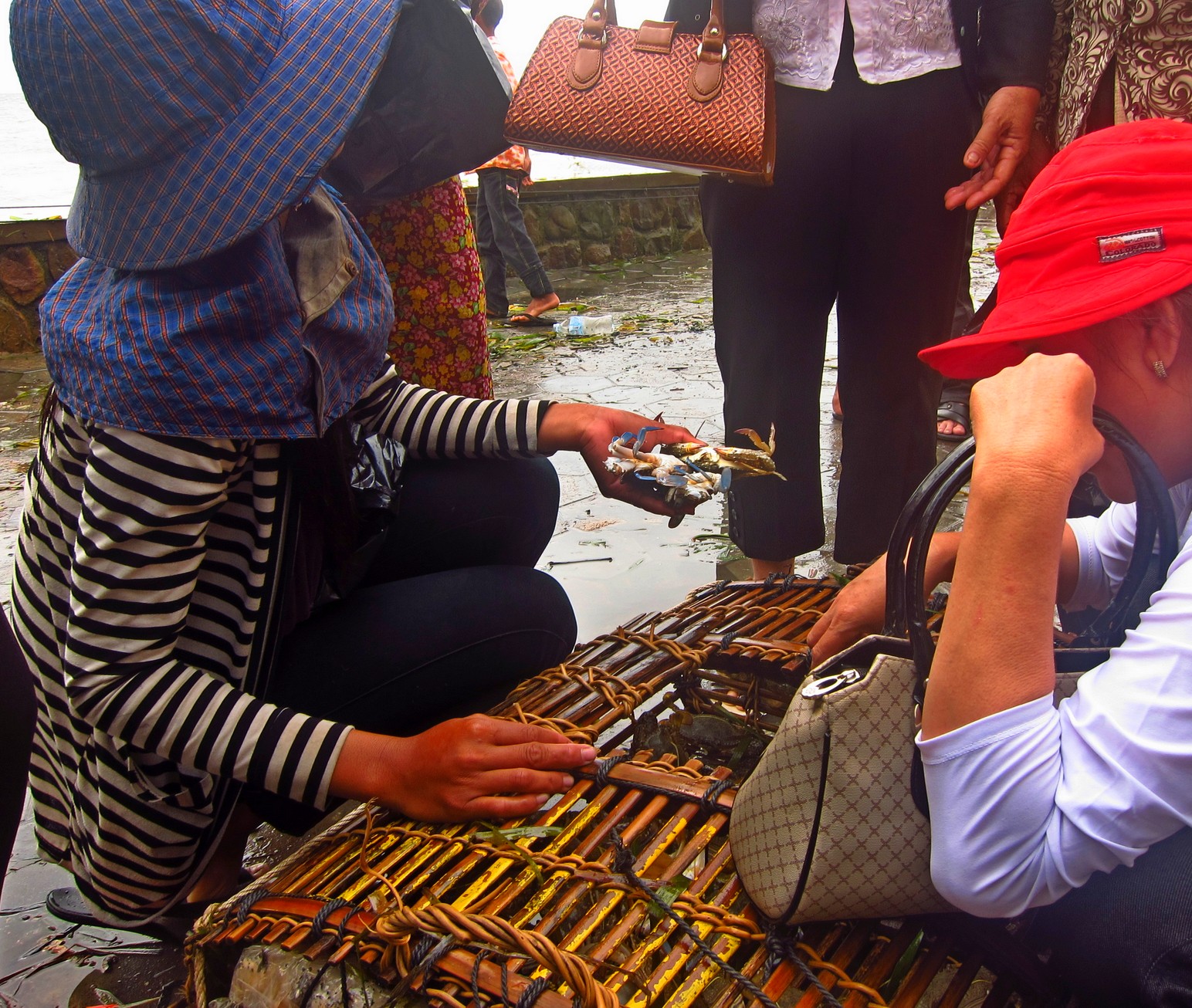
Kampot is home to the famous Kampot peppercorns: fresh, spicy pepper berries served still on the stem that burst with flavor when you bite into them. These delicious little wonders are best showcased when cooked with and served over the equally famous Kep blue crab. We had the dish in each town to compare the awesomeness. The Kampot version was decent, but the one we had in Kep- with a view of the local fishmongers bringing our lunch in from the water- was almost good enough to make us forget how much we missed the beach. Almost.


Even better than eating the crab was visiting the Kep crap market, where the crustaceans are haggled over, sold, cooked and eaten by locals and visitors alike. The market is chaotic- as every good market should be- and we were enthralled as we passed from stand to stand, basket to basket of screamingly fresh seafood.


Next stop: the Mekong. 

A Mekong motorbike ferry
We had our first glimpses of the mythic river in the small, relatively undeveloped Cambodian river settlement of Kratie and the more modern Lao equivalent, Pakse, across the border. Kratie was charming in its dusty simplicity and ended up being the only town in Cambodia that we visited where the people seemed unspoiled- unconcerned even- by tourism.


We started our time in Laos- which we ended up loving- in Pakse, a former French colonial town situated at the confluence of the Mekong and Se Don rivers. Pakse was beautiful and the more laid-back Lao attitude towards tourists was a welcome change from Cambodia.


In Pakse, we rented a motorbike for a day and zoomed around the mountainous countryside outside of the town, passing coffee plantations and bamboo houses along the way. We stopped at a lovely waterfall and spent the afternoon relaxing with our feet in one of the cool, refreshing pools while watching local kids spear fish and splash in the water.

Beers by the waterfall (and yes, I am rocking a shirt-turban)

From Pakse we took an overnight bus up north to Vientiane, Laos' modern capital city, also built on the banks of the Mekong. Throughout the past nine months of traveling, we have taken several overnight buses, all with varying degrees of comfort. But this one took the cake.

We had a bed. 

An actual full-length, surprisingly comfortable twin mattress, complete with pillows and a duvet. It was heavenly enough that the flashing, multicolored neon lights that lined the aisle floor seemed fun and exciting, rather than cheesy and obnoxious. Our only regret was that the trip wasn't longer.

Our party bus
We arrived in Vientiane well-rested, but with low expectations of the city about which we hadn't heard great things. Our experience ended up being better than expected: we had a few excellent meals and thoroughly enjoyed strolling along the city's river-side esplanade at sunset. As the sun goes down, all of Vientiane comes out to walk by the water front and socialize, making it the perfect place to people watch. 


After a couple days in Vientiane, we took yet another overnight bus to Luang Prabang, a gorgeous little city on the Mekong and Nam Ou rivers that boasts the best colonial architecture and cosmopolitan atmosphere in the country. In Luang Prabang we rented another motorbike to visit another comely waterfall where we hiked, picnicked, swam and visited a sun bear sanctuary.

This was exactly what Vincent and I looked like at Lazy Beach
Aside from interesting colonial architecture and a budding culinary scene, Luang Prabang is most famous among tourists for its Buddhist Alms ceremony, when the monks from the town's monasteries walk the streets each morning at sunrise to collect donations of rice and fruit from pious villagers who line the sidewalks. The monks shuffle slowly in a long, silent procession of flowing, bright orange robes in the soft morning light. 


The ceremony is peaceful and moving to watch, if one can ignore the throngs of tourists who yell and push each other aside, shoving their cameras right in the monks' faces to get the best picture. It is disgusting to see and made us feel dirty and ashamed to be in the same category of people as these uncultured sub-humans.

When we had had enough of judging misbehaving tourists, we walked over to Luang Prabang's morning market, which was fascinating. It was early enough in the morning that the market was blessedly devoid of other tourists, who were all presumably too occupied with harassing monks to bother with market-going. We walked by women sitting on the pavement behind spread-out blankets that were covered with fresh greens and colorful produce. There were tables piled high with everything from spices, Lao coffee and flowers to water buffalo tails, live grubs and baskets of rats for grilling. Live toads with their legs tied together wriggled and croaked next to a heap of their less fortunate counterparts, who had been split open to show their freshness, their insides spilling out onto the table. We loved every minute of the market, but our stomachs needed a little down time before we were able to tackle breakfast.

Live grubs and dead frogs at the market
Water buffalo parts anyone?

Luang Prabang also served as the base of another highlight in Laos: the Elephant Conservation Center, or the ECC (www.elephantconservationcenter.com/).

When we were planning our trip around the world, I desperately wanted to visit some place where I could ride an elephant, preferably through a remote, undeveloped Asian jungle. Unfortunately, the reality of elephant tourism in SE Asia is much less romantic. Often the elephants are horribly mistreated, beaten and under-fed. They are made to carry three or four people for up to eight hours at a time- far more than they can healthily do without serious damage to their backs. Adult Asian elephants require around 300 pounds (135 kg) of food and over 100 liters of water a day to thrive, and unfortunately, most of the budget elephant tour operators in SE Asia don't have access to that amount of sustenance.

Having read about the problems associated with elephant tourism, I had all but given up on the idea of having an elephant experience when we came across an advertisement for the Elephant Conservation Center in Sayaboury, Laos. The ECC is first and foremost a sanctuary and veterinary hospital for domesticated elephants, which are still used in the logging industry throughout SE Asia. The center is part of a larger conservation program through the organization ElephantAsia, which aims to slow down the rapidly declining numbers of these endangered animals.

To help fund the project,the ECC has recently started welcoming paying visitors to the center to learn more about the elephants and the conservation efforts surrounding them. We spent three peaceful, informative and fun days at the center, interacting with the elephants, watching them walk, feed and bathe in the lake, and yes, even riding them for a few minutes. 


A short ride ended up being plenty of time, as riding an elephant might just be the most uncomfortable form of transportation there is. And believe me, I've experienced some uncomfortable transportation these past nine months.

Which is a perfect segue to the next leg of our Lao journey. This time, we took a bus further north from Luang Prabang to the lovely little river town of Nong Khiaw in the mountains, and then from there to the unremarkable transit village of Mong Khua via a seven hour boat ride up the Nam Ou river. We were quite excited to travel by waterway, especially on a small boat up a river lined with wild jungle and remote bamboo villages only accessible by water. What we didn't anticipate was just how uncomfortable seven hours on a hard wooden bench would be, particularly when our company on the little eight-person vessel included a hyper-active five-year-old who took a special liking to Vincent and refused to leave us in peace throughout the entire trip. If seven hours in a confined space with a five-year-old isn’t an effective advertisement for birth control, I don’t know what is.

The reason our dads aren't getting grand kids any time soon

Aside from causing my ovaries to go on strike for the foreseeable future, the boat ride was more or less bearable. Unlike our minibus ride from Cambodia to Laos.

Duh duh duuuuh!

This, my friends, is the puke story I promised you in my last post. You see, when we booked our trip from Kratie to the Lao border, we were promised a "VIP minibus."

VIP my ass.

What we got instead was 18 people shoved between backpacks and bags of rice in a vehicle built for 11 passengers. I was smashed with four other people in a seat made for three, with the left side of my bum on top of Vincent's right leg and a little old Khmer lady on my lap.

All of this might have been tolerable had we been on a normal, paved highway. But this was no normal road. This was Cambodia, where the highways have so many potholes that navigating around them feels like a real life game of Mario Kart. Where cars that are already dodging foot-deep trenches in the asphalt must also swerve around packs of dogs, groups of chickens, skinny cows, lumbering water buffalo, people on bikes, people on foot, people on motorbikes, tractors, horses and every other form of transportation imaginable. Trucks loaded high with goods speed by, honking like mad, usually with a family of five sitting on top of the pile, clinging for dear life to the ropes holding the whole operation together.

Well, as I've already given away, this endeavor proved too much for some of my fellow passengers. Two kids, a brother and a sister, had been looking progressively greener as the trip wore on. Luckily, they were by an open window so that they could both hang their heads out to get fresh air. Unluckily, the boy, with no warning or additional movement at all, opened his mouth halfway out the window and proceeded to projectile vomit straight into the wind, which promptly blew the entire ordeal directly back into the face of his sister.

And I mean, directly.

His sister, although understandably shocked, was quick enough to avoid the second onslaught. This batch, however, flew all over the side of the van, and back into the window on the poor German girl sitting next to Vincent. So there we were, wedged together, half the car dripping in child vomit (which, let's be honest, is the worst kind of vomit), speeding around obstacle after obstacle for the three-hour ride to Laos.

Now you might be thinking, "Wow, that sounds miserable." And it was. But, unfortunately, that was not our worst bus ride of the past three weeks.

That honor goes to another "VIP" bus ride we took overnight from Vientiane to Luang Prabang. The trip started out ok: we had another single bed, albeit this time without the disco lights, and we settled in quite comfortably. However, about an hour into the trip, the bus pulled over on the side of the dark highway.

And stayed there. For an hour.

At first, we thought nothing of it- buses often stop for no apparent reason. But we soon realized by the smell of gasoline and the sounds of clanging metal coming from somewhere around the engine, that there was a mechanical problem with the bus.

"No worries," we told each other. "The delay just gives us more time to sleep."

After an hour and a half, we started moving again, only this time, we noticed that the driver had stopped the air conditioning. 

"Not a problem!" we chuckled. "In this mountain air, it won't be too hot at night anyway."

An hour later, we stopped again. Sometime during this second stop, it started to rain and we soon realized that the bus leaked. 
Right onto our bed.

"No need to panic," we tried to convince ourselves. "The wet sheets will keep us cool, since it's starting to get warm in the bus."

The bus started up again and we continued in much the same way, stopping for an hour every hour to let the engine cool off. The rain had stopped, but the temperature in the bus was continuing to rise, causing everything to smell of damp socks.

So the night continued. 

Normally, the journey would have us arrive at 7:00am after eight hours on the road, but since we had been stopped for as long as we had been moving, we were only half way through the journey by the time the sun came up. 

And that's when things got really bad. 

The temperature in the bus spiked with the rising sun, turning the bus into an air-tight mobile sauna. No air con, no fan, no windows that could be opened. It was easily 90 degrees in that f-cking bus and getting hotter every minute. 

As the bus continued its torturous one-hour-on-one-hour-off pattern, we lay dripping with sweat in our single bed, our wet sheets clinging to our roasting, sticky bodies, trying not to touch anything- including each other- and breathing through our mouths so as not to smell the sickening body odor of 60 perspiring passengers.

It was at around the 12th hour of the trip that the first person threw up. 

I can't blame them, of course: 100 degree heat, no air circulation, winding mountain roads and a bus full of sweaty, stinking people is a recipe for disaster. But this one person, this poor, nauseated individual, started what can only be described as the most disgusting chain reaction in history. Person after person started getting sick- loudly- into plastic bags, filling the stifling, humid air with miserable retches and a horrid smell. 

Just imagine this for a second: an inescapable, unrelenting heat, the unmistakable sound of people throwing up all around you, the smell of hot vomit mixing with the stench of a sweaty, unwashed hoard of people who are now on their 16th hour of what was supposed to be an eight-hour VIP bus.

Dear god, it was horrible.

After more than 17 hours of this hell, we finally, finally, pulled into the bus station in Luang Prabang, where it was a violent stampede to get out of the cesspit that was our bus and into fresh air. 

But, you know, it's the journey- not the destination- that matters, right?