Showing posts with label Lessons learned. Show all posts

Sunday, 23 December 2012

When It Ends


So, I’m working on a new theory.

To be fair, I actually stole the theory from Newton and just applied it to things that don’t involve math because, let's face it: math's the worst. But I think I'm onto something.

You’ve all heard of Newton’s Principle of Inertia, right? You know, "the resistance of any physical object to a change in its state of motion or rest, or the tendency of an object to resist any change in its motion." 

Or for my fellow Communications majors out there, the catchier (and easier to understand): “Objects in motion tend to stay in motion, objects at rest tend to stay at rest."

Well I say this theory applies to more than just physics. I think it applies to emotions and lifestyles as well. 

I call it “Emotional Inertia.”

Take us for example (because everything, even the laws of physics, comes back to me):  before we left for our year-long trip, we were “at rest” in Switzerland. We had a good life, a comfortable life, and it was really hard to leave it. We were at rest, and despite our excitement about traveling the world, there was a part of us that tended towards remaining at rest.

It took us a little extra force to get going -an emotional shove out the door, if you will- but once we got “in motion,” we were set. Like a marble on a slanted surface, we started out slowly, but built momentum as we went. As the trip wore on, we were rolling faster and faster: the more we traveled, the more we wanted to travel. The more we talked about a nomadic life, the more we talked about living abroad, about living in a van, etc. etc. etc.

Then, towards the end of the trip, as we were rolling the fastest, we saw something up ahead: The Wall. Our return flight. Our stopping point. There was no removing it, no pushing it back (believe me, we tried; we even called the airline to extend our trip but our ticket had a fixed return date.) The closer we approached that wall, the more we dreaded it. We didn’t want to stop rolling, to stop traveling. We were happy “in motion,” and never wanted it to end.

Then we ran into the wall. 

We stopped. We had to. The stopping point was exactly as you would expect: a slamming halt. A violent, emotional crash.

At first, the crash was slightly softened: we were welcomed at the Marseille airport by Vincent’s entire family, yelling and laughing and crying, holding up signs and drawing curious stares from passersby. That night, the blow was softened further by a wonderful meal with the family, during which we ate all of the products we had missed during the past year and told stories about our trip late into the night. Imagine our marble slamming into the wall and bouncing backwards from the force of impact. That evening was the slow roll back down to the wall.

The next morning though, the wall was still there, and we were stopped at the base of it. We woke up in Vincent’s childhood bedroom and looked around at all of our belongings that we hadn’t seen in a year: my books piled high on the shelves, our clothes hanging in the closet, our wedding rings in a box on the desk. Then we looked at our backpacks, still unpacked on the floor, slumped against a wall in the corner.

And then I started crying. Deep, shuddering sobs of mourning and loss, my head buried against Vincent’s chest as he rested his chin on the back of my head, struggling with his emotions in silence.

We were both overwhelmed: how do we reconcile all of these things, these objects of our past, with the dirty, crumpled backpacks on the floor? More importantly, how to we reconcile the two worlds they represent?

But, as all emotions do, the fear passed. After a day or so of bewilderment and anxiety, we finally worked up the courage to start unpacking our backpacks, organizing our belongings, getting ready to start over. We both put on a pair of jeans for the first time in a year. I wore leather boots, and a real bra, marveling at the unfamiliar reflection in the mirror. Slowly, we were getting back to normal.

That was a week ago. Today, we are more or less “at rest.” We are starting to think about what we are going to do next, starting to think about the future. We are easing ourselves into it all by planning to travel around a lot in the next few weeks to visit friends and family, but we are beginning to accept that that too has to end. We have to stay at rest for a while.

And, as Newton predicted, now that we are at rest, we are ok being at rest. We still want to get back into motion again in the future: we are already talking about doing another big trip in a few years. But first we need to settle down for a while, at least long enough to save up for the next adventure. And now, for the first time since we left for the trip, settling down doesn’t sound so bad. To our surprise, there’s a small part of us that looks forward to being in one place for a little while. It looks forward to having a home again, to resume building our lives together. We are at rest and we will stay at rest.

Until the next trip.

Friday, 15 June 2012

Half-Time

Yesterday was the day I had been dreading.

I started anticipating its approach about a month ago, bracing myself against its onslaught. I expected the realization of its significance to hit me like a ton of bricks, forcing me with its arrival to acknowledge my deepest feelings and doubts.

Well, none of that came to pass. Like a minor birthday or anniversary, this seemingly-important day came and went with an anti-climactic "wah waaaaah".

Yesterday, you see, was the half-way point of our trip. In exactly six months, we will have taken the last flight of our round the world ticket. In six months we’ll be back in Europe. Back home.

In six months, it will all be over.

So you can imagine that we expected to feel some profound emotion about the passing of that milestone: pride, dread, relief, I don’t know, something.

But really, the only thing we felt was acceptance.  We realize that we have as much time ahead of us as we do behind us; that there is as much opportunity to experience the world as we have already experienced in the last six months.

And we can accept that.

We have no regrets, no bad feelings about the passing of time, no real desire to slow down or speed up the clock. Looking back, we have done a lot since the start of the trip. On one hand, it feels like the time has flown by, but on the other hand, we feel like the start of our trip was years ago.

For example, I was thinking about our jungle tour the other day and what we were wearing during certain parts of it. It was an unexpected shock to realize that the clothes in our backpacks back then are the exact same clothes that are still in our backpacks almost six months later. The jungle feels like another trip completely, something far off in our pasts. It’s as if traveling has become our normal, everyday life, and each new place we go is a separate mini-vacation that has nothing to do with the previous destination.

People keep asking us how we are feeling now that we are half way through our trip: Are we still liking it? Are we sick of travelling? Have we started thinking about what we will do when it’s over? The short answer is yes, no and kinda.

The long answer is that we are (still) loving this trip. Seriously, I don’t know how better to express it. This has been the best decision of our lives and we are having an absolute blast. Every new place we go and new experience we have teaches us more about the world, about each other and about ourselves.

And it’s fun. Whether we are visiting a chaotic market in Bolivia with dead sheep opened up on the sidewalk, having a heated political discussion with one of our volunteering hosts or road-tripping around New Zealand in a giant camper van singing George Michael songs, we are having a fantastic time and making memories that we will never forget. I don’t know how better to explain it without sounding like a Hallmark card.

And no, we are not sick of travelling. For that, I thank our decision to volunteer along the way. Staying in one place to work for a few weeks every three months or so gives us a much-needed break from the little stresses and discomforts of backpacking that can wear on you after a while. Volunteering gives us a break from hostels and bus rides, from spending money and constantly being on the move. By the time we are finished with a volunteering assignment, we are ready, excited even, to get back on the road. This little respite, in addition to the invaluable learning opportunity working abroad provides us, makes volunteering one of the best parts of the trip.

Before we started this year-long adventure, we were worried about the things that we would have to live without, the comforts of “normal” life that we would miss along the way. Highest on that list was our own space: our own glorious, comfortable, solitary place that we could call our own. Surprisingly though, we haven’t really had a problem finding that, even on the road. We had it in our tiny cabin on the farm when we were volunteering in Argentina, when we rented an apartment in Chile, when we had our camper van in New Zealand. Sure, it’s not our own couch in our cozy apartment in Switzerland, but we quickly adapted and realized that it is possible to find our own little space in the world, no matter where we are.

There are a few things, however, that we do miss. Before I get into them, let me preface it by saying that these are tiny, insignificant little holes in our comfort. They are puny nothings and do not hinder our enjoyment of the trip in the least. I always feel like the biggest a-hole complaining or talking about what I don’t have when I am in the middle, literally, of an incredible life experience that few people are lucky enough to have. So, please, take this with a grain of salt and forgive me for being an insolent, unappreciative brat, especially after you hear what I'm about to say.

I miss looking good. There, I said it. It’s lame, I know, but it’s true. I miss dressing up and wearing heels.  I miss picking out an outfit, doing my make-up and then looking in the mirror and loving what I see (and yes, I said that too: loving it). It’s been over six months since I have used a hair dryer, since I’ve worn heels or perfume or lipstick. It’s been six months since I’ve worn jeans for god’s sake. And I actually miss all of that. I find myself looking at pictures Vincent took of me to test his camera before the trip with a kind of nostalgic longing that one normally reserves for a someone who has passed away. I mean, look at the “before” pictures:


RIP, hot stuff.

And now look at what I’ve been reduced to after six months of zip-off pants and sports bras.


Oh, the androgyny!

At first, having a minimalist beauty routine and wardrobe was liberating. It felt good not to care. But, damnit, I do care. And I’m not the only one.

Vincent has admitted as well that he’s fed up wearing the same convertible pants every day. He’s sick of having only one option when he wants to dress up, which happens to be exactly what he wears when he dresses down. He too longs for his old wardrobe of nice clothes and something other than hiking shoes to put on when we go out.

And it’s not just us. Other long-term travelers we talk to say the same thing. I remember one Swiss guy we met who had been traveling for five months and said that he couldn’t wait to get back to work simply because he wanted to wear a suit again. I wouldn’t go that far, but I do understand the sentiment.

Beyond our wardrobes- and this too will induce serious eye rolls- we also miss working out and having a routine for staying in shape. Yep, we are those assholes, the kind who actually miss exercising. True, we do quite a bit of walking and hiking, but I miss running so bad it hurts and Vincent yearns for his daily (well, every other day) hour at the gym. Yes, we can do make-shift exercises in our hostel room or I could run in my hiking shoes, but it’s not the same. Neither of us miss having any other routine- our jobs can suck it, for example- but not working out, really working out, has been much more difficult than we expected.

And it shows. As Vincent says, we are both a little “soft” these days…

But other than those two tiny complaints, we really don’t miss anything else. Sorry, that sounded douchey: of course we miss our friends and families too, but we expected that.  And honestly, with our friends and family spread out all over the world, we often go six months without seeing many of our loved ones anyway.  

The last question we get- do you know what you are going to do after the trip?- is one that I can’t even begin to answer in any way that isn’t flaky and noncommittal and confusing. But of course I’ll try anyway, mostly because I love the sound of my own voice.

We have had a lot to consider between the different places we have been and the kinds of volunteer work we have been doing. I personally have driven Vincent crazy with my repetitive assertion nearly every place we go that “I could live here.” It drives him insane, but it’s true! Buenos Aires, Auckland, Sydney, the countryside inland from Byron Bay; I could totally live in any of those places. Or I could happily go back to Switzerland.

See why this makes Vincent want to throw things?

Really, we are still so open that the only tentative plan we have for when the trip is over is that we are going to look for jobs in any of the places mentioned above (and any other we love in the coming six months) and see what comes up. If that's not flaky and non-committal, I don't know what is.

So that is our half-way checkup: what’s good (pretty much everything), what’s bad (lookin’ like a dude all the time) and what’s to come (most likely more places I’ll want to live in).

To wrap this up, I’ll tell you a little story to illustrate my previously expressed woes. I was looking through the “cute” pictures of me from before the trip when Vincent asked me what I was doing.

“Oh, I’m looking at pictures of myself before the trip.”

“Back when you were skinny and tan?” Vincent asked.

With a look that I hoped would turn my husband into a smoldering pile of ash, I responded, “Back when I was skinny?!”

As if correcting me, Vincent added, “And tan." 


Monday, 9 April 2012

Rosie's House

I have been meaning to write this post for several days now, but I just couldn't seem to get it done.

It may be because I haven't had the time. When we weren't working, we were usually at the table having leisurely meals full of excellent food, wine and conversation with Rosie, our host. It may also be simply because I didn't know what to say. How do I explain this experience in a way that does it justice?

Someone recently asked me what has been the highlight of this trip so far, which got me thinking: what do I consider a "highlight" among a collection of experiences, sights, people and moments that are all memorable, whether they are good or bad? Trekking to Machu Picchu was certainly unforgettable, but so was the night in Sucre when we sat around our hostel courtyard with new friends and drank a case of wine, laughing and sharing stories until early morning.

Our most recent highlight falls into the latter category, that is, the experiences we have that are memorable because they are so human.We spent the last two weeks volunteering in the same region of Patagonia where we worked previously, but this time, at the home of Rosie, a middle-aged British woman who has been living in Argentina for over 30 years. Rosie lives by herself in a small wooden house on four remote acres of land and takes in a few backpackers a year to help her with gardening, fruit picking and landscaping. As "payment" for the work, she provides room and board.

But that exchange, manual labor for basic hospitality, isn't the point. Far from it.

Yes, we worked, but that part of the experience was largely forgettable. What made this place, and this person, a highlight of our trip was the exchange that went far deeper than work or meals. The true exchange took place when we would all cook together, Vincent and I clumsily learning to fold the dough to close our homemade empanadas, or watching as Rosie took yet another of her fresh fruit crumbles out of the oven. The exchange happened at the end of the meal, as one of us would serve the others another glass of wine, the conversation flowing easily. It happened when the three of us went out in town to watch a Spanish guitar concert at the small venue run by one of Rosie's acquaintances and then discussed the musical styles we like on the drive home. At those times, no one was counting work hours or making sure everything was perfectly equal. It wasn't a work exchange; it was a friendship.

And it was an opportunity for us to learn. We learned about a lifestyle that is far removed from our own- one of simplicity, little waste, sustainability and community. Rosie lives in a house smaller than our old apartment; a house heated by a fireplace enclosed in brick so as to radiate heat throughout the little area. She cooks on a wood-burning stove, which also acts as a heater, as well as an oven. She line-dries her clothes and doesn't own a TV, a dishwasher or a microwave. Her car is old enough to vote.

Rosie produces only one small plastic grocery bag of non-recyclable trash a week. Organic waste is composted, paper is burnt, glass and aluminum re-used or recycled. Her sink and bathwater are drained directly back to the land for irrigation. She and the neighbors in her small, rural community swap and share the various goods they produce: homemade jams, chutneys, juices and beers.

Rosie eats almost exclusively whole foods, often organic and mostly local, but not because it is a current trend. She doesn't buy these products to feel self-righteous about being a responsible consumer. She buys them because it's economical and ecological, and in doing so, she is supporting local producers, like herself, who are trying, often in vain, to live off the land. Her lifestyle is not easy, and part of its simplicity is a result of necessity, not ideology. Yet despite its perceived discomfort or inconvenience, there is something deeply appealing about the idea of only having what you need.

Witnessing Rosie's lifestyle and the simple comfort of her home has made us re-evaluate what we need in order to have a good quality of living. Do we really need a microwave? A dryer? Do any of us really need two or three guest rooms in our house? More than one car per adult, or a new car instead of a used one? It's so easy to confuse what we want, or what other people have, with what we actually need, and often, the more we have, the more unsatisfied we are.

While traveling, we have witnessed whole populations living with much, much less than what we consider necessary in our own countries. We have had a taste of living more simply just by backpacking with the bare essentials. But living with Rosie has been our first opportunity to experience the reality of it. It's the first time we have been able to ask about the benefits and drawbacks, to really understand what it means to simplify. And it has given us a lot to think about.

That's not to say we are going to go all Thoreau on you and go live an isolated life in the woods. It's not even to say that we will change the way we live or consume when the trip is over. It is certainly not to say that you should change your habits. I don't have the answers for myself, so I won't even begin to pretend that I have the answers for anyone else. But it has made us reconsider the way we live and the way we want to live.

Our time with Rosie taught us countless other things too. We have learned about Argentine and British culture, as well as how this particular region has changed over the last few decades. We have learned about the effects of tourism and immigration on a place, the tensions that run deep among a diverse population. We have learned a new style of cooking, which, I have to say again, is amazing. Rosie is truly a superior cook and after two weeks of eating her masterpieces, I have the thighs to prove it. We have learned the art of conversation from a host who is intelligent, funny, engaging and thoughtful.

But above all, above the endless conversations about politics, religion, environmental awareness, wine, Facebook, cooking and every other topic imaginable; above the cultural exchange and the appeal of the simple life; above everything else, we have learned that true hospitality, in its purest, most generous form, is possible.

Rosie welcomed us into her home in the fullest sense, making us feel comfortable immediately. Within a day, we felt like we were visiting an aunt or a family friend, someone whom we had known for years. Some days, when we would come in from work to find tea and cake sitting out for us or when Rosie would rub clay on my wasp stings to draw out the poison and soothe the pain, we felt like little kids at Grandma's house. It was comfortable, and comforting, and was the most "at home" we have felt since we started traveling.

To realize that this complete stranger opened her house and herself to us so readily was to witness a kind of humanity that one rarely, if ever, experiences. It is humbling and inspiring, and it makes us realize just how much potential there is by simply opening oneself to other people.

We could all stand to learn a lesson or two from someone like Rosie. I only hope that we have been able to share with her even a portion of what she has taught us.

Although if we haven't, I know she isn't keeping score.

Hard at work bunching lavender
One of our daily lunches in the garden (homemade vegetable tart and salad)
Purple Peruvian Potatoes (say that three times fast...)
The empanadas we helped make

Sunday, 6 November 2011

Obligatory anti-materialism post

So here it is, my rant against consumerism (conveniently posted before I reveal just how much this trip will cost us...). Brace yourself, this might get ugly...

I assume that anyone who willingly restricts their belongings to what will fit into a backpack for a year goes through some realization during their trip that they normally live with much more than they actually need. I expected to go through that well into the trip, during that freeing moment when my pathetically limited choice of clothing stops being a restriction and starts being a form of liberation. I certainly didn't expect to feel this way before we even left.

We are currently preparing ourselves for the move out of our apartment and part of that process has been going through everything we own and trying to get rid of what we can. Now, I will give us a little credit here: both V and I are really good about minimizing clutter. Neither of us are packrats by any means and for the most part, we don't let ourselves get emotionally attached to material things. If you look around our apartment, we don't have a lot of random objects that just sit on shelves or in drawers in that purgatory of being kept "just in case." You know what I'm talking about- that drawer everyone has full of pens that no longer work, batteries that may or may not be dead, broken jewelry or dishes that you plan to repair one day, little trinkets that people have brought you back from vacation... Generally, we are pretty good about getting rid of that kind of stuff.

That said, going through all of my belongings this past weekend made me realize that I have SO much stuff, and that I don't need or even want the vast majority of it. That realization and the ensuing purging of said stuff was both freeing and depressing.

The act of giving away a bunch of my clothes, shoes and beauty products- all of the random things I've accumulated over the years- felt so liberating. I feel lighter, more streamlined, and feel like I can see what I have more clearly and actually appreciate my belongings. I gave away or donated (or, in the case of old t-shirts and undies, simply threw out) five huge bags of stuff that I don't need, use or want. Don't believe me? These are just the "give away" bags:


And these are all of the beauty products that I've barely used and jewelry that I never wear.

All of those bottles, boxes and tubes are completely FULL.

Why it took me this long to get rid of all of this crap and why I even had it in the first place is beyond me.

Which brings me to the depressing side of my epiphany.

As I went through my stuff-- shoes that were too uncomfortable to wear, jeans that had been too big for four years (thank you, active Swiss lifestyle) but that I had kept just in case the chunk came back, perfume and make-up that I had bought just because I was bored-- I was forced to acknowledge that I had made some pretty terrible choices as both a consumer and an owner of goods. I had several items of clothing that I had worn maybe once but that I had never been able to bring myself to get rid of  just in case I wanted to wear them again. I had half-empty bottles of lotion, perfume and make-up that I was always saving for a special occasion and that had since gone bad. I had, and this is where it really got difficult, tons of clothes, accessories and jewelry that people had given me as gifts and that I didn't actually like or use but felt bad about giving away.

I realized that all of it- the clothes, the products, the gifts- weighed on me. They distracted me and took space, time and energy away from the things I had that I actually liked. Every morning when I got ready for the day, I would open my closet and have to mentally separate the wearable from the unwearable. Then I'd sort through the jewelry that I never used to find the pieces that I actually liked. Then I'd have to push aside mostly empty bottles of old lotion to get to the one that had something in it. I never realized just how much energy that took until I didn't have to do it anymore. It feels incredible.

Decidedly less incredible was the process of actually sorting through it all- note my dejection as I realized just how much crap we had:

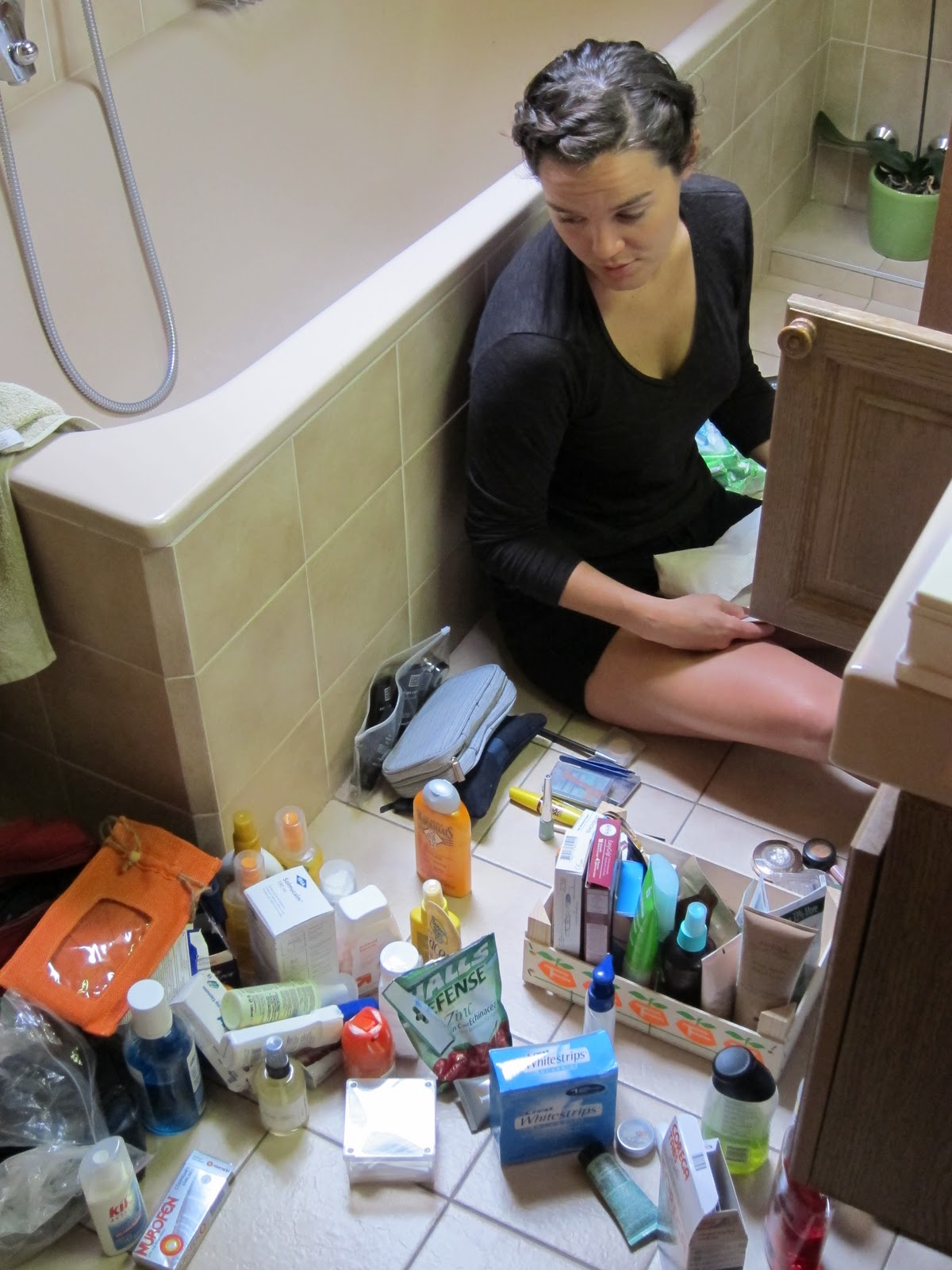
Going through the contents of our bathroom cabinet and hating life.
During the course of my purging, I also separated the clothes that I will need in the coming weeks before the trip from those that can go directly into storage until we get back. I grabbed around 25 of my favorite pieces from which I will choose to clothe myself for the next two months. It will take some creativity to mix things up and not wear the same five outfits every week, however I'd rather be challenged to get the most out of what I have rather than keep more than I need. Just opening my closet and only seeing the things that I love to wear has turned me into a born-again minimalist.

The point of all of this is that I want to learn from this experience and remember how this feels so that when we come back from the trip, I will change my consuming habits. Granted, I still love clothes and make-up and don't plan to become a hunter gatherer or anything, but I can make small changes to become a more discerning buyer so that everything I acquire actually goes to use.

I promise I'm wrapping this up, but at the risk of sounding even more like a sanctimonious a-hole, I want to end this with a quick round-up of the needless waste that made me feel the worst, the goal being that I can read this later and not make the same mistakes.

Of all of the things I got rid of, the following made me hate myself the most:
  • A massive amount of half-empty bottles of beauty products, make-up compacts, boxes of medicine, etc. I was horrified to actually have to look at the pile of stuff that was going to waste just because I didn't finish a product before buying a replacement or because I had been saving a product for special occasions and then forgotten about it completely. And I want to share my horror with you:
It looks innocent enough, but let me assure you, that pile was taking over my bathroom floor.
  • A trash bag full of cheap clothes. While I put aside a few bags of nicer things to give to friends, I still had a full bag of clothes that were of such poor quality that I was embarrassed to offer them to people I knew because they looked like hell after one or two wears. It's too easy to go into one of those cheap stores (I'm looking at you, H&M) and buy a bunch of crap I don't need simply because it doesn't cost much. In the end, I can't get much use out of what I bought because it falls apart easily or fits poorly, making it much worse of a deal in the long run than a more expensive, quality item that I wear all the time. Ditto for sale items that I would never buy at full price but that I just can't pass up because it's such a good deal! Cost per use and quality over quantity are my new mottoes.
  • Travel products taken from business hotels. Now, I love an adorable miniature shoe shine sponge as much as the next gal, but seriously, do I really need four (FOUR!) gallon-sized ziploc bags of hotel shampoos, shower gels, and the like? Of course not. I'm lucky enough to be able to afford shampoo, and chances are, so are you, so believe me when I say that it is not worth it. Not only is it a waste when you don't use them, but even if you do, the amount of plastic that goes towards producing those cute little bottles is heartbreaking.
  • Gifts. This one really makes me feel like an a-hole, but if I want to be honest about what I've learned, I need to address it. If you are someone who may need to give me a gift in the future, please don't. I'm serious. From now on, please, if you absolutely must give me something, make it consumable, i.e. edible, drinkable or able to fit in an envelope. No more things, I'm begging you. I am picky to the point that I can hardly buy for myself, so it is an exercise in futility for others to try to pick something out for me. Of course, I appreciate the thought and generosity, but 9 times out of 10, the gifts I receive sit in the back of my closet, jewelry box or drawer of batteries until I give it away. I realize just how awful that sounded, but if it saves even one person I care about from wasting money on a gift I will never use, it will be worth it.
So there they are, my life lessons learned from one weekend of clearing out our apartment. I can't even imagine how enlightened I'll be by the end of this trip. Step aside, Buddha.