Showing posts with label boat. Show all posts

Wednesday, 24 October 2012

Trash and Trekking

I hated Sapa.

We had only been there about 45 minutes and already I was fed up.

“This is AW-ful,” I moaned, head fogged with sleep deprivation as I flipped through our trusty Lonely Planet, trying to find another place, any place, to escape to.

Admittedly, I may have been jumping the gun a little bit. We had arrived in Sapa at 5:30am via an overnight bus on which I wasn’t able to sleep at all. Staggering off the bus exhausted and grumpy, I was emotionally unequipped to deal with the hostel touts who were yelling at us, pulling at our arms, doing everything possible to harass us into coming to their guesthouse. I know touts are a part of traveling, especially in this part of the world, but that morning I was so tired and miserable that I wished death- or at least grave personal injury- on each and every one of them.

We thought that we would have some respite once we had chosen a guesthouse, but it didn’t stop there. Instead of hostel touts, we were surrounded and subsequently followed by three women from the Hmong hill tribe, who tried to convince us to hire them as tour guides to visit their village. At any other time, on just a bit more sleep, this wouldn’t have bothered me so much, but I was not in the mood. Their attempts to engage us (“Where are you from? Is that your husband? Very handsome.”) seemed sinister and deceitful, their colorful traditional costumes came across as a plot constructed solely for the purpose of ensnaring naïve tourists. Normally, I am not this jaded, but that morning, I had had enough.

However, like most things, my bad attitude was nothing that a good nap couldn’t fix. After a few hours of sleep and a coffee, the little black cloud that had followed me since arriving in Sapa had cleared. My world was bright and sunny again. And Sapa wasn’t so bad after all.

We had come to Sapa to trek through the terraced rice paddies and hill tribe villages that are tucked away in the mountains surrounding the town. Before arriving, Vincent learned about a Sapa-based organization called Sapa-O-Chau (www.sapaochau.org) that educates disadvantaged youth from the hill tribes and trains many of them to be trekking guides; so we headed to their offices to get information about trekking. While we were discussing various trekking options with the manager, he mentioned that things were busy for him at the moment because he was organizing a big event the next day during which the school’s students would walk from village to village picking up trash and raising awareness about responsible and sustainable waste disposal.

“Can we help?” I asked, unthinking, and without consulting Vincent and Elodie, who were immediately implicated by my offer.

Luckily, they were just as keen to get involved and the next day, we found ourselves in rubber gloves with a few other volunteers and around 30 students, picking up trash along the road. It was a gorgeous day, sunny and warm. We had a great time talking to the students and other volunteers and feeling like we were a part of something helpful and important. It was fascinating to see this group of students from various villages, many dressed in their tribe’s traditional costume, coming together to lead an effort that would benefit the whole community. These “under-privileged” kids were an inspiration: their motivation to make their surroundings healthier and more beautiful was both humbling and encouraging.


The amount of garbage was staggering and it was impossible to collect all of it, but we quickly realized that the day was more about awareness than trash collection. All along the way, villagers and tourists alike would ask us what we were doing and were interested in our effort. Some bystanders even joined in and helped us pick up trash as we passed, including small children who would make a game out of the pick-up, challenging each other to see who could collect the most candy wrappers.

The walk through the villages also gave us a sneak peak of the region’s unique scenery that would dominate our trek the following day. We had signed up for a two-day trek with a Sapa-O-Chau guide along with two other volunteers from South Africa that we had met during the trash pick-up. We were six people in all with our adorable 19-year-old guide Lan, who had a quick smile and an infectious barking laugh.

The landscapes we passed through were incredibly stunning: several times we would round a bend and all just stop, speechless, as we were hit with the view in front of us. Dramatic, green hills puncturing a low-hanging haze and then plummeting into deep valleys. Terraced rice paddies that climbed up the side of mountains, army-green and gold with late-harvest rice stalks. We were incredibly lucky to be in the area during the two-week harvest period:  the paddies were alive with activity. We watched whole families cutting the rice grass by hand while eight-year-old boys herded the water buffalo that would till the cut terraces with their hooves. We passed groups of people picnicking in the fields, taking a break from the difficult labor, and children playing in the bins used to collect the rice. The soundtrack of our trek was the deep, muted, drum-like rhythm of the farmers beating fist-fulls of dry grass against a wooden bin to loosen the grains. It was fascinating and we were grateful to be able to witness these ancient local rituals that were so integral to the region’s culture.

A young water buffalo shepherd

A Hmong woman looks on while Vincent gets rabies
Look closely and you will see the 10-inch knife in the little boy's hand. Who needs toys when you have sharp objects? (Photo by Elodie)

At one point we passed a group of children playing under the supervision of an elderly man. We were taking photos of the kids and laughing as we showed them the result in the camera’s viewfinder when the old man started gesticulating wildly, pointing at our cameras and speaking animatedly to Lan. We were concerned that the man was angry at us for taking pictures of the kids, but Lan explained that no, he wasn’t upset: he simply wanted his picture taken as well. The man posed, grinning as Leslie, the South African girl in our group, took a portrait of him. He was simply beside himself with excitement to see the picture and laughed with abandon when Leslie showed it to him. His mirth was contagious and soon all of us- the children, Lan, the old man, our little group of tourists- were laughing together, sharing a simple moment of joy that needed no translation.

Our new buddy and his charges
Quite possibly the two cutest kids in Vietnam (Photo by Shaun Children)
Our trek included an overnight homestay with a family, who were part of the Red Dzao tribe. While the Hmong people are known for their colorful indigo-dyed outfits, complete with woolen gaiters on their legs, the Red Dzao tribe are distinguished by their bright red head-dresses. The head-dresses are striking, however some women opt for red fabric lined with white, which, if I’m honest, looks uncannily like a Santa Claus hat.  I know, my cultural sensitivity is inspiring…

The homestay was not only a great time (excellent home-cooked food, awesome company), but it was also extremely comfortable. During every other trek we have done, the beds in the homestays are mats or thick blankets on the floor, but here, we had massive beds with pillows and mosquito nets! It was an unexpected, and extremely appreciated, luxury. To top it off, we were also treated to a Red Dzao tradition: hot, herb-infused baths. Our hosts boiled locally-grown medicinal herbs in a massive cast-iron pot and then mixed the scalding water with fresh water in wooden barrels for us to sit in and soak away our aches and pains. I don’t know if there is anything in this world that feels better after a 6-hour trek than a beer, a delicious meal and a hot herbal bath.

Helping Lan make spring rolls for dinner
Our host, making dinner in her "Santa Hat"
Soaking away his worries (except the one about his wife taking pictures of him at bath time...)
And now for the obligatory social commentary portion of this blog post.  Our homestay was interesting, but not in the way we expected. What surprised us was just how similar the family was to any other family in any other place in the world.  Yes, the mother had on her Santa Claus hat and the children were all dressed in traditional tribal dress, but that’s where the differences ended. While the mom cooked dinner (over the kitchen’s open fire on the ground), the kids did their homework. During dinner, as we tourists raved over the tasty spread of dishes in front of us and chatted about our day, the whole family ate silently, eyes fixed on the TV, where a Chinese program dubbing into Vietnamese was playing. They all started out at the table, until one by one, they turned their chairs towards the TV with apologetic smiles, taking their plates in their laps. It was the normalcy of the situation and the family that struck us. When we travel, we always focus on how things, and people, are different from where we come from, when in fact we should be looking at what we all have in common. Of course there are massive cultural differences, but beyond the superficial, we really aren’t all that different.

And with that cloyingly clichéd observation, let’s jump to our next destination: Ninh Binh, a smallish city a few hours south of Hanoi. We took the blissfully comfortable overnight train from Sapa and arrived in Ninh Binh with two days to explore. The city is a bit off the main tourist track, which was its biggest draw for us. Although we loved our trek in Sapa, we were becoming concerned that Vietnam was so firmly on the tourist trail that we would never get to know the “real” side of the country. Thankfully, we saw it in Ninh Binh, where strangers still waved to us in the streets and vendors didn’t try to add a couple thousand extra dong to the prices of meals.

The countryside surrounding Ninh Binh is known as the “terrestrial Halong Bay” due to its soaring green karst cliffs and rock formations that protrude from the otherwise-flat ground. We rented scooters to explore the area (Vincent and Elodie on one and me bringing up the rear on the other) and zoomed through country roads and small towns that rarely see tourists.

A flooded graveyard outside Ninh Binh
We culminated the adventure with a boat trip in a protected flood area during which a sweet young woman rowed us in a cramped wooden sampan along the base of the towering cliffs and through a cave.  


On our way back to Ninh Binh, we passed through a tiny village whose narrow winding streets wouldn’t have been out of place in Italy. Between the scooter and my giant sunglasses, I felt like a trendy Italian, zipping through the back streets of Rome.

That is, until I remembered that I was wearing convertible pants… 


Saturday, 6 October 2012

Good Morning, Vietnam

It’s 5:30 in the morning and I’m on the back of a complete stranger’s motorbike, zipping through the streets of Hanoi. The early morning air is still blessedly cool, the growing light still dim. In almost any other city in the world this time of day would be quiet, peaceful even.

But this is Vietnam. And at 5:30am in Hanoi, it is madness.

Motorbikes buzz by us like a swarm of bees, grazing my elbows as they pass. The traffic of bikes, cars and roaring trucks flows like a river through intersections; the lack of traffic lights transforming every side street into a tributary. There is constant honking on all sides of us as the sidewalks, alive with activity, speed by in a blur. 

A man on a motorbike passes us, straddling two freshly butchered pigs, their lifeless hooved legs bouncing as the bike flies over the pavement. We zoom past a woman on a bicycle, a conical hat tied with a red checkered bow under her chin. On the handlebars of her bike hangs a live chicken, its legs tied together over the metal bar so that it sways upside down like a feathered handbag. On every side of us people pass on their motorbikes, most wearing surgical face masks to protect them from pollution. I vaguely wonder why I don’t have a face mask when we are cut off by a scooter driven by a young women who deftly steers her bike with one hand. With the other hand she is holding a tiny baby on her knee like a sack of groceries as she weaves through the traffic.

We pass a lakeside park where crowds of people are doing their morning exercises. There are countless joggers around the lake and groups of 50 people doing Tai Chi or following an instructor in an open-air aerobics class. Old men in sandals stretch against a tree trunk. Several people are playing badminton on sidewalk courts, while others kick around a soccer ball. It’s incredible: the sun has just risen, the shops are still shut tight behind metal grates, the office buildings won’t open for hours, but the streets are positively packed with people.

Crazy-busy streets seem to be the norm in Hanoi, regardless of the time of day. The narrow streets are a constant stream of motorbikes, making the city a veritable obstacle course for pedestrians. We quickly learned that if you wait for a break in traffic to cross a street, you will wait forever; so we did what the locals do: take a deep breath, close your eyes and just walk, letting the traffic go around you. Any hesitation or back step will throw off the timing of the endeavor and is the best way to get hit by a bike. You just have to walk with confidence and trust that the drivers hurdling towards you are paying attention.


Hanoi is crazy and dynamic, and seems to be the most Asian of the cities we have visited. Communism has left its mark and while there are a few Western chain restaurants and shops, the city is largely resistant to mass tourism and globalization. Yes, there is the typical tourist ghetto that one finds in nearly every big city, but it only comprises of a street or two and is easy to avoid. Just a block or so from the tourist center and one finds local bars serving 40-cent beers and market stands selling dog meat. It’s authentic, frenetic and fascinating. And it hit us like a punch in the face after the laid-back tranquility of Laos.


A dog meat stand in the market
Commie propaganda 
Men playing Mah Jong outside of a temple

We had a couple days to kill before we were to meet Vincent’s sister Elodie in Hanoi, so we headed out to Cat Ba Island via a bus-boat-bus-bus combo that sounded way more complicated than it actually was. Cat Ba Island is one of the larger islands (or possibly the largest, I'm too lazy to Google it) in Lan Ha Bay, which connects to the famed (and overly-touristic) Halong Bay. Both bays are famous for their striking natural beauty: tall karst cliffs blanketed in green trees that jut out of turquoise waters. It really is an incredible area and Cat Ba Island ended up being a perfect jump-off point to explore it.

To get a feel for the bays, we took a one day/one night boat trip through Lan Ha and Halong Bay, passing through floating fishing villages and stopping to swim in the clear blue water and kayak in hidden coves among the towering rock formations. That night, we slept on the roof of our boat, which was docked in one of the protected natural harbors in Lan Ha Bay. We enjoyed a delicious meal as the sun dropped behind the cliffs and woke up with the sun as it rose again, bathing the harbor in soft, pink light.


Vincent and his beard on a boat
Sleeping on the roof of the boat at dawn
One of Halong Bay's floating villages

The next day we decided to do something a little more adventurous: free climbing on the cliffs over the bay. We piled with two other climbers and a climbing guide into a small dinghy and headed to a slightly over-hanging cliff which dropped off into deep water. The boat would bring us up the the cliff face, where we would climb onto the rock. Once we were on, the boat would back away, leaving nothing below us but our safety net: the water. With no ropes or harnesses to hold us, we climbed until we couldn’t go any further or until we got tired (which, honestly, wasn’t all that high- we are relative beginners when it comes to rock climbing). When we were ready to drop, we would let go of the rock, pushing off slightly to clear anything jutting out below us and falling around 30 feet (10 meters) into the water below.

It was a blast. And, if I'm honest, we felt pretty badass telling people we had free climbed in Halong Bay, like we were a couple of extreme sports enthusiasts instead of complete beginners.


We could have stayed longer in Cat Ba, but we had a date to make: we had to meet Elodie in Hanoi. It was so strange and wonderful to meet up with family on the other side of the world. The first five minutes were quite surreal, but then we all fell back into our normal ways and before we knew it, we felt like Elodie had been traveling with us the whole time. We spent another couple days in Hanoi shopping, getting a massage and eating some delicious food from street vendors and beer houses, where we enjoyed our meals elbow to elbow with locals who were all too happy to explain to us just how incorrectly we were eating specialties like dried beef and green papaya salad, fried tofu with tomato and garlic sauce, and noodles with beef and fresh mint.

After several days in Hanoi, we were ready for something a little more peaceful, a slower pace. We were ready for Sapa, Vietnam’s trekking capital. 

But that is another post entirely. Laos and Cambodia kind of got the shaft on this blog, what with all the rushing and the lumping, so I'm not about to make the same mistake with Vietnam. If history has taught me anything, it's this:  
You don't f-ck with Vietnam.


Saturday, 22 September 2012

Race Against Time: Cambodia and Laos

In my last post I promised to stop with the proselytizing about how evil American military policy is and get back to the travel stories- particularly those that are funny, miserable, disgusting, or preferably all three. And I intend to keep that promise. 

For the past three weeks, we have raced through 13 destinations, taking in the rest of Cambodia and all of Laos in a hectic, conical-hatted blur. We were racing for a cause: we needed to be in Hanoi by September 18th to meet up with Vincent's sister (and my beloved sister in law) Elodie, who is going to travel with us through Vietnam for two weeks. Even though we had a good reason to rush, thirteen places in 21 days is a lot. Like, bordering on travel fatigue a lot.

As exhausting as it's been to be constantly on the move, we have had some crazy experiences: some crazy good, and some crazy bad. Let's start with the good, but be forewarned: this is one long-ass post.

From our beach paradise, we headed to the sister towns of Kampot, a small river town in southern Cambodia, and Kep, an even smaller beach town an hour away. Both were pleasant enough, but we weren't there for the sights. We were there for the food.

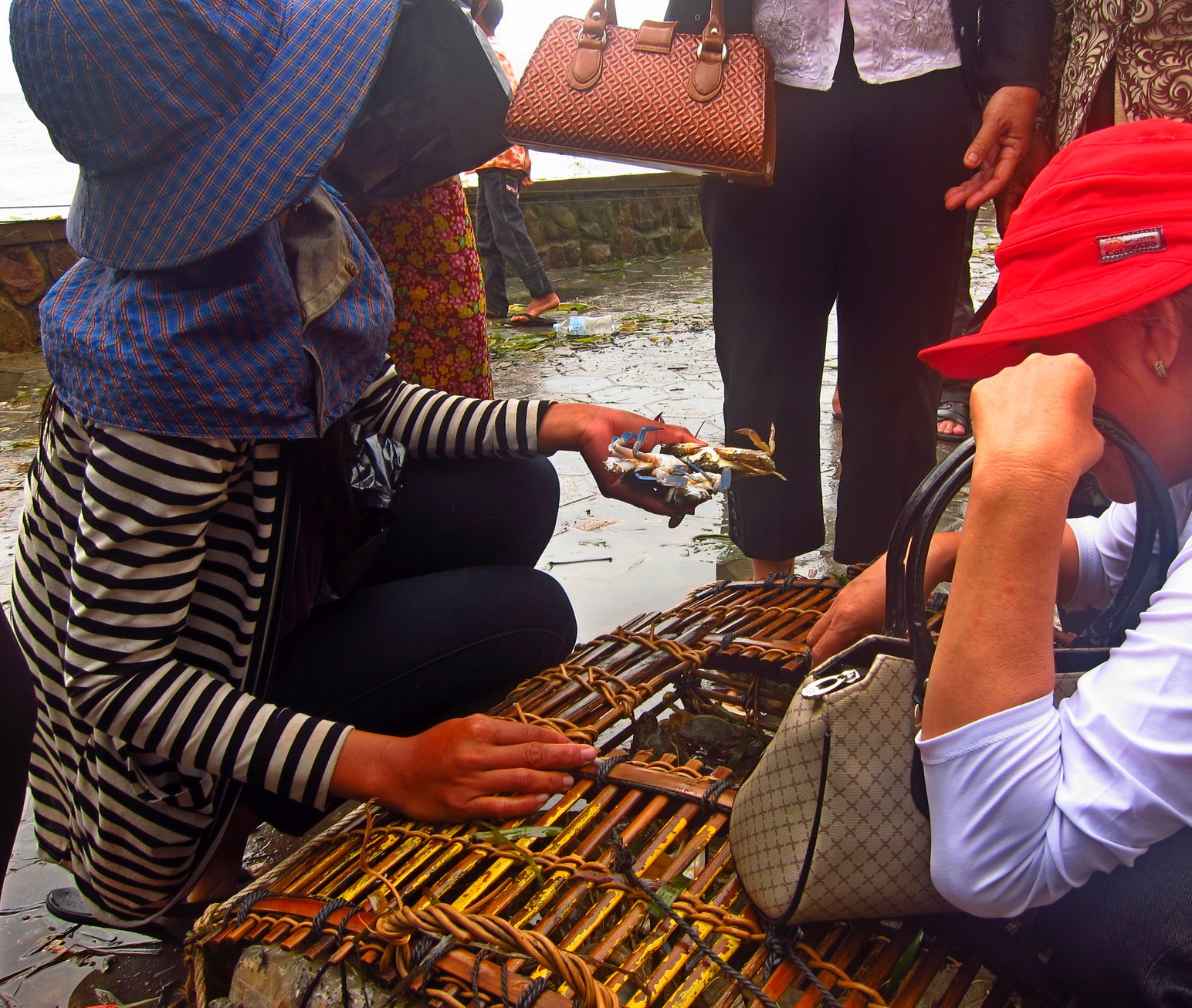
Kampot is home to the famous Kampot peppercorns: fresh, spicy pepper berries served still on the stem that burst with flavor when you bite into them. These delicious little wonders are best showcased when cooked with and served over the equally famous Kep blue crab. We had the dish in each town to compare the awesomeness. The Kampot version was decent, but the one we had in Kep- with a view of the local fishmongers bringing our lunch in from the water- was almost good enough to make us forget how much we missed the beach. Almost.


Even better than eating the crab was visiting the Kep crap market, where the crustaceans are haggled over, sold, cooked and eaten by locals and visitors alike. The market is chaotic- as every good market should be- and we were enthralled as we passed from stand to stand, basket to basket of screamingly fresh seafood.


Next stop: the Mekong. 

A Mekong motorbike ferry
We had our first glimpses of the mythic river in the small, relatively undeveloped Cambodian river settlement of Kratie and the more modern Lao equivalent, Pakse, across the border. Kratie was charming in its dusty simplicity and ended up being the only town in Cambodia that we visited where the people seemed unspoiled- unconcerned even- by tourism.


We started our time in Laos- which we ended up loving- in Pakse, a former French colonial town situated at the confluence of the Mekong and Se Don rivers. Pakse was beautiful and the more laid-back Lao attitude towards tourists was a welcome change from Cambodia.


In Pakse, we rented a motorbike for a day and zoomed around the mountainous countryside outside of the town, passing coffee plantations and bamboo houses along the way. We stopped at a lovely waterfall and spent the afternoon relaxing with our feet in one of the cool, refreshing pools while watching local kids spear fish and splash in the water.

Beers by the waterfall (and yes, I am rocking a shirt-turban)

From Pakse we took an overnight bus up north to Vientiane, Laos' modern capital city, also built on the banks of the Mekong. Throughout the past nine months of traveling, we have taken several overnight buses, all with varying degrees of comfort. But this one took the cake.

We had a bed. 

An actual full-length, surprisingly comfortable twin mattress, complete with pillows and a duvet. It was heavenly enough that the flashing, multicolored neon lights that lined the aisle floor seemed fun and exciting, rather than cheesy and obnoxious. Our only regret was that the trip wasn't longer.

Our party bus
We arrived in Vientiane well-rested, but with low expectations of the city about which we hadn't heard great things. Our experience ended up being better than expected: we had a few excellent meals and thoroughly enjoyed strolling along the city's river-side esplanade at sunset. As the sun goes down, all of Vientiane comes out to walk by the water front and socialize, making it the perfect place to people watch. 


After a couple days in Vientiane, we took yet another overnight bus to Luang Prabang, a gorgeous little city on the Mekong and Nam Ou rivers that boasts the best colonial architecture and cosmopolitan atmosphere in the country. In Luang Prabang we rented another motorbike to visit another comely waterfall where we hiked, picnicked, swam and visited a sun bear sanctuary.

This was exactly what Vincent and I looked like at Lazy Beach
Aside from interesting colonial architecture and a budding culinary scene, Luang Prabang is most famous among tourists for its Buddhist Alms ceremony, when the monks from the town's monasteries walk the streets each morning at sunrise to collect donations of rice and fruit from pious villagers who line the sidewalks. The monks shuffle slowly in a long, silent procession of flowing, bright orange robes in the soft morning light. 


The ceremony is peaceful and moving to watch, if one can ignore the throngs of tourists who yell and push each other aside, shoving their cameras right in the monks' faces to get the best picture. It is disgusting to see and made us feel dirty and ashamed to be in the same category of people as these uncultured sub-humans.

When we had had enough of judging misbehaving tourists, we walked over to Luang Prabang's morning market, which was fascinating. It was early enough in the morning that the market was blessedly devoid of other tourists, who were all presumably too occupied with harassing monks to bother with market-going. We walked by women sitting on the pavement behind spread-out blankets that were covered with fresh greens and colorful produce. There were tables piled high with everything from spices, Lao coffee and flowers to water buffalo tails, live grubs and baskets of rats for grilling. Live toads with their legs tied together wriggled and croaked next to a heap of their less fortunate counterparts, who had been split open to show their freshness, their insides spilling out onto the table. We loved every minute of the market, but our stomachs needed a little down time before we were able to tackle breakfast.

Live grubs and dead frogs at the market
Water buffalo parts anyone?

Luang Prabang also served as the base of another highlight in Laos: the Elephant Conservation Center, or the ECC (www.elephantconservationcenter.com/).

When we were planning our trip around the world, I desperately wanted to visit some place where I could ride an elephant, preferably through a remote, undeveloped Asian jungle. Unfortunately, the reality of elephant tourism in SE Asia is much less romantic. Often the elephants are horribly mistreated, beaten and under-fed. They are made to carry three or four people for up to eight hours at a time- far more than they can healthily do without serious damage to their backs. Adult Asian elephants require around 300 pounds (135 kg) of food and over 100 liters of water a day to thrive, and unfortunately, most of the budget elephant tour operators in SE Asia don't have access to that amount of sustenance.

Having read about the problems associated with elephant tourism, I had all but given up on the idea of having an elephant experience when we came across an advertisement for the Elephant Conservation Center in Sayaboury, Laos. The ECC is first and foremost a sanctuary and veterinary hospital for domesticated elephants, which are still used in the logging industry throughout SE Asia. The center is part of a larger conservation program through the organization ElephantAsia, which aims to slow down the rapidly declining numbers of these endangered animals.

To help fund the project,the ECC has recently started welcoming paying visitors to the center to learn more about the elephants and the conservation efforts surrounding them. We spent three peaceful, informative and fun days at the center, interacting with the elephants, watching them walk, feed and bathe in the lake, and yes, even riding them for a few minutes. 


A short ride ended up being plenty of time, as riding an elephant might just be the most uncomfortable form of transportation there is. And believe me, I've experienced some uncomfortable transportation these past nine months.

Which is a perfect segue to the next leg of our Lao journey. This time, we took a bus further north from Luang Prabang to the lovely little river town of Nong Khiaw in the mountains, and then from there to the unremarkable transit village of Mong Khua via a seven hour boat ride up the Nam Ou river. We were quite excited to travel by waterway, especially on a small boat up a river lined with wild jungle and remote bamboo villages only accessible by water. What we didn't anticipate was just how uncomfortable seven hours on a hard wooden bench would be, particularly when our company on the little eight-person vessel included a hyper-active five-year-old who took a special liking to Vincent and refused to leave us in peace throughout the entire trip. If seven hours in a confined space with a five-year-old isn’t an effective advertisement for birth control, I don’t know what is.

The reason our dads aren't getting grand kids any time soon

Aside from causing my ovaries to go on strike for the foreseeable future, the boat ride was more or less bearable. Unlike our minibus ride from Cambodia to Laos.

Duh duh duuuuh!

This, my friends, is the puke story I promised you in my last post. You see, when we booked our trip from Kratie to the Lao border, we were promised a "VIP minibus."

VIP my ass.

What we got instead was 18 people shoved between backpacks and bags of rice in a vehicle built for 11 passengers. I was smashed with four other people in a seat made for three, with the left side of my bum on top of Vincent's right leg and a little old Khmer lady on my lap.

All of this might have been tolerable had we been on a normal, paved highway. But this was no normal road. This was Cambodia, where the highways have so many potholes that navigating around them feels like a real life game of Mario Kart. Where cars that are already dodging foot-deep trenches in the asphalt must also swerve around packs of dogs, groups of chickens, skinny cows, lumbering water buffalo, people on bikes, people on foot, people on motorbikes, tractors, horses and every other form of transportation imaginable. Trucks loaded high with goods speed by, honking like mad, usually with a family of five sitting on top of the pile, clinging for dear life to the ropes holding the whole operation together.

Well, as I've already given away, this endeavor proved too much for some of my fellow passengers. Two kids, a brother and a sister, had been looking progressively greener as the trip wore on. Luckily, they were by an open window so that they could both hang their heads out to get fresh air. Unluckily, the boy, with no warning or additional movement at all, opened his mouth halfway out the window and proceeded to projectile vomit straight into the wind, which promptly blew the entire ordeal directly back into the face of his sister.

And I mean, directly.

His sister, although understandably shocked, was quick enough to avoid the second onslaught. This batch, however, flew all over the side of the van, and back into the window on the poor German girl sitting next to Vincent. So there we were, wedged together, half the car dripping in child vomit (which, let's be honest, is the worst kind of vomit), speeding around obstacle after obstacle for the three-hour ride to Laos.

Now you might be thinking, "Wow, that sounds miserable." And it was. But, unfortunately, that was not our worst bus ride of the past three weeks.

That honor goes to another "VIP" bus ride we took overnight from Vientiane to Luang Prabang. The trip started out ok: we had another single bed, albeit this time without the disco lights, and we settled in quite comfortably. However, about an hour into the trip, the bus pulled over on the side of the dark highway.

And stayed there. For an hour.

At first, we thought nothing of it- buses often stop for no apparent reason. But we soon realized by the smell of gasoline and the sounds of clanging metal coming from somewhere around the engine, that there was a mechanical problem with the bus.

"No worries," we told each other. "The delay just gives us more time to sleep."

After an hour and a half, we started moving again, only this time, we noticed that the driver had stopped the air conditioning. 

"Not a problem!" we chuckled. "In this mountain air, it won't be too hot at night anyway."

An hour later, we stopped again. Sometime during this second stop, it started to rain and we soon realized that the bus leaked. 
Right onto our bed.

"No need to panic," we tried to convince ourselves. "The wet sheets will keep us cool, since it's starting to get warm in the bus."

The bus started up again and we continued in much the same way, stopping for an hour every hour to let the engine cool off. The rain had stopped, but the temperature in the bus was continuing to rise, causing everything to smell of damp socks.

So the night continued. 

Normally, the journey would have us arrive at 7:00am after eight hours on the road, but since we had been stopped for as long as we had been moving, we were only half way through the journey by the time the sun came up. 

And that's when things got really bad. 

The temperature in the bus spiked with the rising sun, turning the bus into an air-tight mobile sauna. No air con, no fan, no windows that could be opened. It was easily 90 degrees in that f-cking bus and getting hotter every minute. 

As the bus continued its torturous one-hour-on-one-hour-off pattern, we lay dripping with sweat in our single bed, our wet sheets clinging to our roasting, sticky bodies, trying not to touch anything- including each other- and breathing through our mouths so as not to smell the sickening body odor of 60 perspiring passengers.

It was at around the 12th hour of the trip that the first person threw up. 

I can't blame them, of course: 100 degree heat, no air circulation, winding mountain roads and a bus full of sweaty, stinking people is a recipe for disaster. But this one person, this poor, nauseated individual, started what can only be described as the most disgusting chain reaction in history. Person after person started getting sick- loudly- into plastic bags, filling the stifling, humid air with miserable retches and a horrid smell. 

Just imagine this for a second: an inescapable, unrelenting heat, the unmistakable sound of people throwing up all around you, the smell of hot vomit mixing with the stench of a sweaty, unwashed hoard of people who are now on their 16th hour of what was supposed to be an eight-hour VIP bus.

Dear god, it was horrible.

After more than 17 hours of this hell, we finally, finally, pulled into the bus station in Luang Prabang, where it was a violent stampede to get out of the cesspit that was our bus and into fresh air. 

But, you know, it's the journey- not the destination- that matters, right?